
Genus: Bromeliads
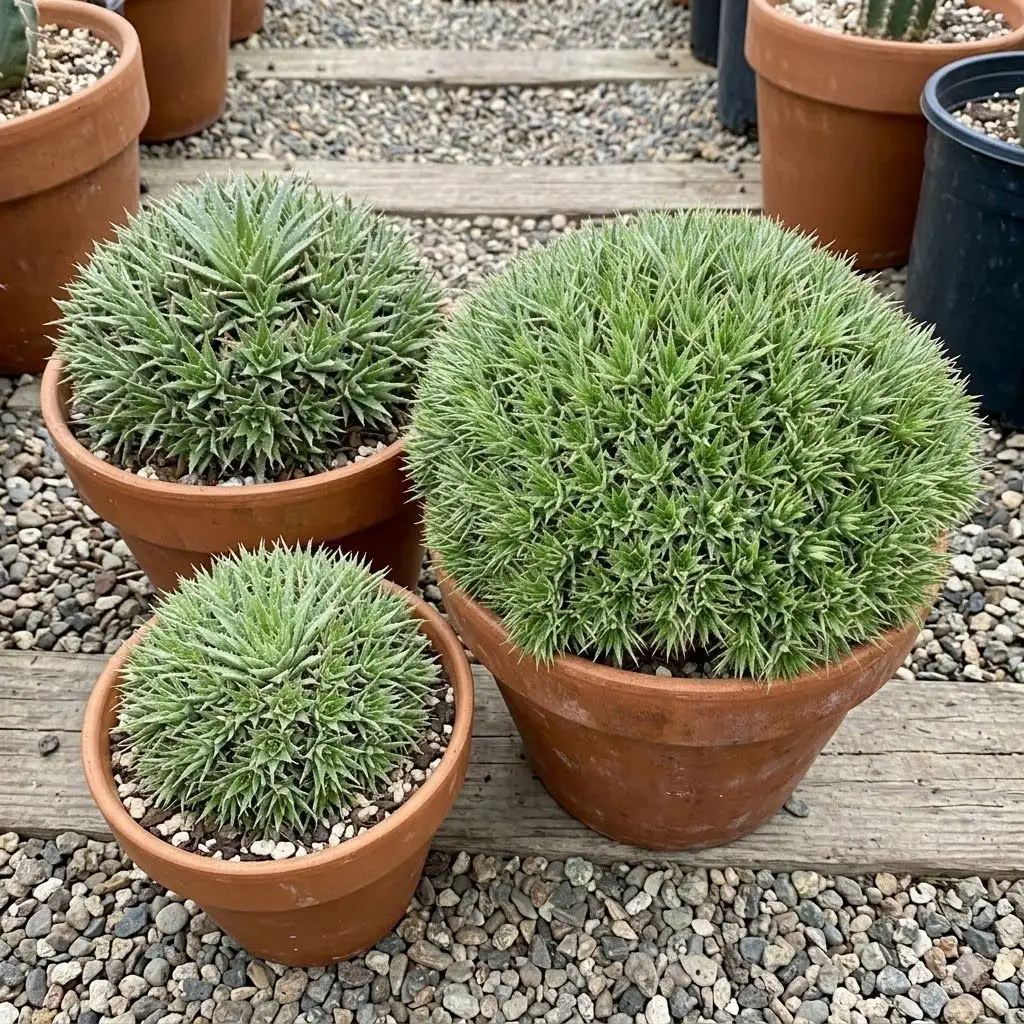
Abromeitiella
Abromeitiella
Genus of terrestrial and rupicolous bromeliads forming dense cushions of tiny rosettes. Endemic to the Andes of Bolivia and Argentina, it grows on rocky outcrops and stony slopes between 2,500 and 4,200 m a.s.l. Its rigid, spiny leaves form compact cushions that can reach several meters in diameter over time. Phylogenetically close to Deuterocohnia, with which it shares the subfamily Pitcairnioideae.
Acanthostachys
Acanthostachys
Monospecific genus of terrestrial and epiphytic bromeliads native to South America. Characterized by long, rigid, spiny leaves and a pineapple-like orange-red inflorescence.
Aechmea
Aechmea
Alcantarea
Alcantarea
Genus of giant bromeliads endemic to Brazil, mainly from rocky outcrops (inselbergs) in the Atlantic Forest. Their monumental rosettes can exceed 2 metres in diameter. Formerly classified in Vriesea, it was segregated based on morphological and genetic differences.
Ananas
Ananas
Genus of terrestrial bromeliads native to tropical South America, world-famous for Ananas comosus, the edible pineapple. Their rosettes form central water reservoirs and the characteristic inflorescence produces an edible syncarpous infructescence in cultivated species.
Andrea
Andrea
Araeococcus
Araeococcus
Billbergia
Billbergia
Brocchinia
Brocchinia
Bromelia
Bromelia
Canistropsis
Canistropsis
Canistrum
Canistrum
Catopsis
Catopsis
Cottendorfia
Cottendorfia
Cryptanthus
Cryptanthus
Deuterocohnia
Deuterocohnia
Disteganthus
Disteganthus
Dyckia
Dyckia
Edmundoa
Edmundoa
Encholirium
Encholirium
Fascicularia
Fascicularia
Small genus of terrestrial or lithophytic bromeliads endemic to Chile. Distinguished by their dense cushion rosettes and the striking phenomenon of the central leaves turning intense red during flowering, serving as a visual signal for pollinators. More cold-tolerant than most bromeliads.
Fosterella
Fosterella
Glomeropitcairnia
Glomeropitcairnia
Greigia
Greigia
Guzmania
Guzmania
Hechtia
Hechtia
Hohenbergia
Hohenbergia
Hohenbergiopsis
Hohenbergiopsis
Lymania
Lymania
Mezobromelia
Mezobromelia
Neoregelia
Neoregelia
Nidularium
Nidularium
Pitcairnia
Pitcairnia
Portea
Portea
Genus of epiphytic or rupiculous bromeliads endemic to eastern Brazil, mainly the Atlantic Forest. Their large funnel rosettes produce highly ornamental branched inflorescences with brightly coloured bracts and blue-violet flowers. Closely related to Aechmea.
Pseudananas
Pseudananas
Monospecific genus of terrestrial bromeliads native to South America, morphologically very close to Ananas (pineapple). Differs mainly by its long, robust stolons used for vegetative spread, and by producing viable seeds. Does not produce edible fruits.
Puya
Puya
Quesnelia
Quesnelia
Genus of epiphytic or terrestrial bromeliads endemic to Brazil, mainly the Atlantic Forest. Their funnel or tubular rosettes feature leaves that are sometimes silver-banded with marginal spines. The dense, compact inflorescences produce pink, red, or bluish flowers. Related to Aechmea and Nidularium.
Racinaea
Racinaea
Ronnbergia
Ronnbergia
Sincoraea
Sincoraea
Streptocalyx
Streptocalyx
Tillandsia
Tillandsia
Ursulaea
Ursulaea
Vriesea
Vriesea
Werauhia
Werauhia
Genus of epiphytic bromeliads segregated from Vriesea by J.R. Grant in 1995, with about 80 species distributed in Central America, the Caribbean, and northern South America. Distinguished from Vriesea mainly by bicomate seeds — with plumose filaments at both ends — and floral structure details. Mainly inhabits cloud forests and tropical rainforests from lowlands to montane zones.
Wittrockia
Wittrockia